
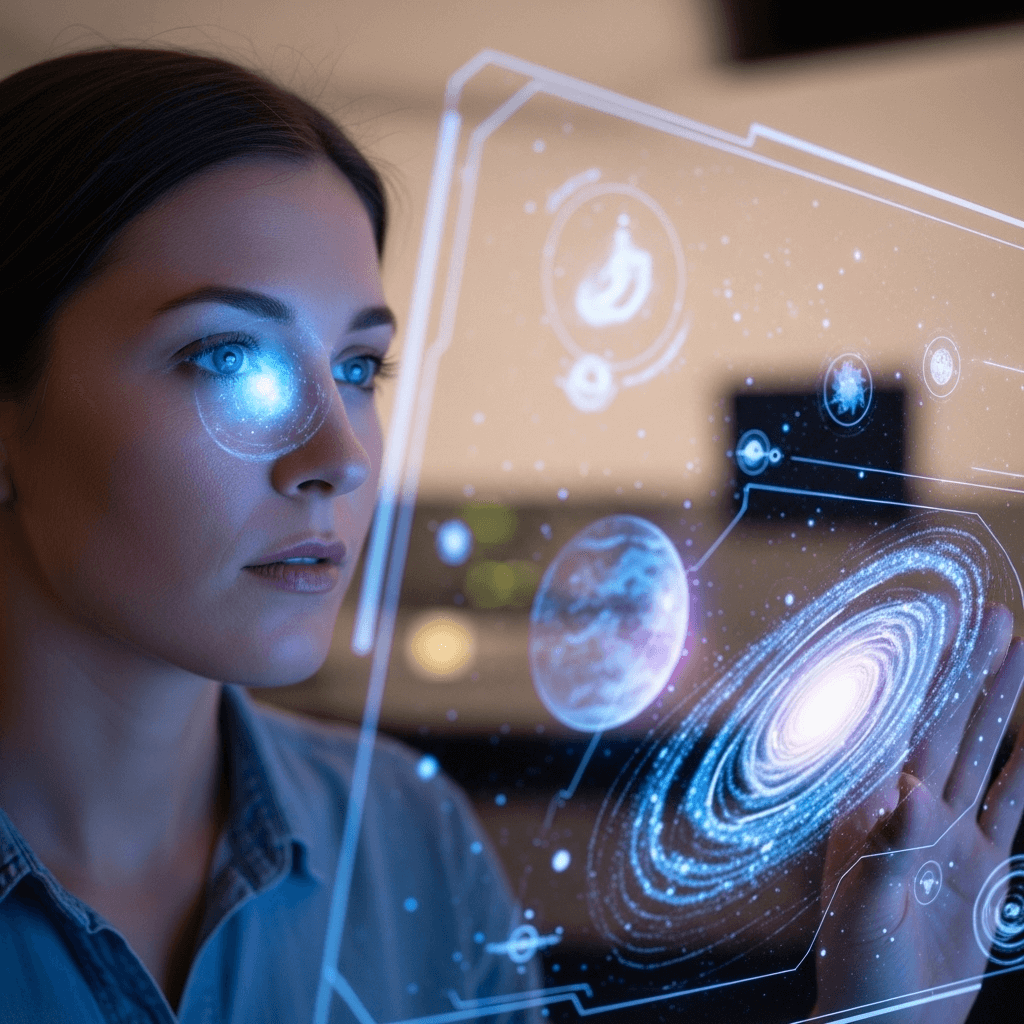
AI & Astronomy: Unveiling the Universe’s Hidden Events
The universe constantly presents awe-inspiring cosmic events, from exploding stars to distant galaxy mergers. For centuries, astronomers diligently observed the cosmos. However, the sheer volume of data from modern telescopes now challenges human capacity. Fortunately, artificial intelligence (AI) is rapidly transforming how we detect, analyze, and understand these incredible celestial phenomena, opening new frontiers in cosmic discovery.
AI’s Role in Taming Astronomical Data
Today’s powerful telescopes, such as the Square Kilometre Array (SKA) or the Vera C. Rubin Observatory, generate truly staggering amounts of data—petabytes daily. Manually sifting through this colossal cosmic stream to find fleeting events, like a distant supernova or a rapid fast radio burst (FRB), is simply impossible for human astronomers alone. Consequently, this is where artificial intelligence in astronomy, particularly machine learning algorithms, offers a groundbreaking solution. AI systems effectively process and interpret vast datasets with unparalleled speed and accuracy, revolutionizing astronomical data analysis.
For instance, AI algorithms can quickly identify anomalies that signify a potential cosmic event detection. They learn to distinguish real signals from noise, thereby dramatically reducing false positives. Scientists now employ AI to classify millions of galaxies and stars, improving our understanding of galactic evolution. Moreover, AI aids in the detection of transient events. When a star explodes, becoming a supernova, AI can spot the sudden surge in brightness, even in crowded fields of stars. Similarly, machine learning in space helps pinpoint the elusive, millisecond-long bursts of radio waves known as FRBs, which remain one of the universe’s great mysteries. Therefore, AI transforms telescopes from mere data collectors into intelligent AI celestial discovery machines.
Unveiling the Universe’s Hidden Secrets with AI
Beyond simply handling massive data, artificial intelligence and space exploration empower astronomers to uncover cosmic events previously undetectable or extremely challenging to find. One remarkable example is the detection of gravitational waves. These ripples in spacetime, caused by cataclysmic events like colliding black holes or neutron stars, produce incredibly faint signals. LIGO and Virgo observatories generate complex data where AI algorithms play a crucial role. These algorithms sift through the noise to identify the subtle patterns characteristic of a gravitational wave event, significantly enhancing discovering cosmic events rates and accuracy.
Furthermore, AI is making astronomical observation more dynamic and responsive. Automated telescope systems, powered by AI, can identify a potential cosmic event and then autonomously re-point telescopes to capture more data, sometimes even alerting other observatories worldwide in real-time. This agility allows for rapid follow-up observations of transient phenomena, providing critical insights before the event fades. Consequently, AI is not just processing existing data; it is actively guiding new observations and helping us observe the universe’s most enigmatic and ephemeral occurrences, leading to breakthroughs in our cosmic understanding. This truly showcases how AI is changing space exploration and hints at the exciting future of astronomy with AI.
In conclusion, artificial intelligence has profoundly reshaped our approach to discovering cosmic events. By efficiently managing immense astronomical data and precisely identifying subtle cosmic signals, AI empowers astronomers to uncover the universe’s most elusive phenomena. This technological synergy between human ingenuity and machine learning promises an even more exciting future, as AI continues to expand our cosmic horizons and reveal the universe’s deepest, most fascinating secrets.
For more information, visit: The Indian Express